By Alistair Johnstone
If you've ever thought, "I know what I should do, so why do I still hold back?" you're not broken. You're human. Most people think confidence is something you're born with. I don't buy that, and I never have. Confidence is a skill. You build it the same way you build strength: consistent reps, honest feedback, and a process you can stick to when motivation dips.
When people search for a confidence coach UK service, they're rarely looking for hype. They're looking for change they can feel in day-to-day life: speaking up in meetings, setting boundaries, walking into difficult conversations without shrinking, and following through on commitments to themselves.
I've rebuilt my own confidence the hard way - through sobriety, discipline, and honest work when nobody was clapping. That's exactly why my approach is practical. No fluff, no pretending, no "just think positive" nonsense. Just a structure that helps you become someone who trusts themselves again.
Key Takeaways
- Confidence is a trainable skill, not a fixed personality trait
- Real confidence grows through action, reflection, and accountability
- The confidence-competence loop explains why small wins matter so much
- Imposter syndrome softens when you gather evidence, not reassurance
- A good coaching process gives you structure, challenge, and momentum
What Is Confidence Coaching, Really?
Confidence coaching is a focused, forward-looking coaching process designed to help you act with more certainty, consistency, and self-trust in the areas that matter most to you.
In practice, that means we work on things like:
- Speaking with clarity instead of second-guessing every sentence
- Taking action before you feel "perfectly ready"
- Setting standards and boundaries without guilt
- Building routines that reinforce self-respect
- Recovering quickly after setbacks rather than collapsing into self-criticism
A confidence coach isn't there to run your life for you. My job is to help you see your blind spots, challenge patterns that keep you small, and build a repeatable way of operating that keeps working long after the session ends.
If you want the broader picture of how coaching works, start with what is life coaching. If you already know confidence is the thing holding you back, confidence coaching is the direct route.
If you want practical daily actions to start now, read how to build confidence.
Why Confidence Matters More Than Most People Realise
People often treat confidence like a "nice to have". In real life, it's a performance variable. It affects how you communicate, what opportunities you pursue, how you negotiate, how you parent, how you lead, and how well you recover when life punches you in the mouth.
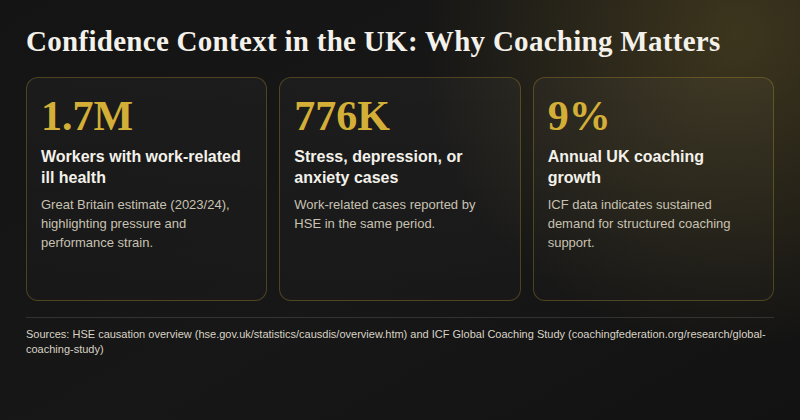
The HSE's latest workplace statistics report that 1.7 million workers experienced work-related ill health in Great Britain, including 776,000 cases linked to stress, depression, or anxiety. When your confidence is low, pressure feels heavier, decisions get slower, and avoidance becomes normal.
There's also a social cost. The Campaign to End Loneliness highlights that millions of people in the UK experience chronic loneliness. Low confidence and isolation feed each other: the less certain you feel, the more you withdraw; the more you withdraw, the less capable you feel.
Then there is demand. The ICF Global Coaching Study points to continued growth in coaching, including around 9% annual growth in UK coaching activity. People are not paying for coaching because it's trendy. They're paying because action beats overthinking.
The Confidence-Competence Loop (And Why It Changes Everything)
One of the most useful frameworks I teach is simple:
Action -> Competence -> Confidence -> Bigger Action
Most people wait for confidence before they act. That keeps them stuck. In reality, confidence usually arrives after repeated action.
Here's what that looks like in everyday life:
- You do one uncomfortable thing (speak first in a meeting, make the call, post the video).
- You survive it and often do better than you feared.
- Your competence improves because you've now done a rep.
- Your confidence rises because you have evidence, not fantasy.
- You take the next step.
This is exactly how I rebuilt after difficult years in my own life. Not by waiting to feel ready. By showing up when I didn't. Sobriety taught me this in the most direct way possible: confidence follows commitments kept.
If your goals sit in career growth, identity shifts, and better standards, personal development coaching is built around this loop.
Imposter Syndrome: How I Work With It in Coaching
Imposter syndrome is one of the most common issues clients bring to coaching. It sounds like:
- "Soon they'll realise I'm winging it"
- "I got lucky"
- "I'm behind everyone else"
- "I need one more course, one more qualification, one more year"
I treat imposter syndrome as a pattern, not an identity. We break it down into three practical steps.
1) Separate facts from fear
We list what is objectively true: results you've delivered, problems you've solved, feedback you've received, and responsibilities you've earned. Fear gets loud when evidence is vague. So we make the evidence concrete.
2) Replace mind-reading with behaviour
Most imposter thinking is prediction: "They think I'm not good enough." We stop guessing and focus on behaviour: what you will say, what you will deliver, what boundary you'll hold, what standard you'll meet.
3) Build proof through controlled exposure
Confidence grows when you repeatedly do what you avoid. We set specific reps each week, then review what happened. This is where this approach creates momentum fast: you stop treating confidence like a feeling and start treating it like a practice.
For many clients, this is the turning point. They stop trying to "feel confident" and start behaving like someone who backs themselves.
What Sessions With Me Look Like
People often ask what actually happens in session, so here's the straight answer.
We start with honesty, not performance
You don't need a polished story. You don't need to impress me. We begin with where you're genuinely at: what you're avoiding, what you're tolerating, and where your confidence drops in real situations.
We build a personal confidence map
We identify your pressure points across work, relationships, self-talk, health routines, and boundaries. Then we choose high-leverage actions that can shift your week immediately.
We set commitments you can actually keep
Not ten vague goals. A few clear actions with deadlines, context, and standards. I care less about intensity and more about consistency.
We review with honesty and zero drama
If you followed through, we build on it. If you didn't, we don't beat you up - we diagnose what happened and adjust the system. This is why coaching works: no guessing, no hiding.
This structure sits at the core of my empowerment coaching, where we focus on confidence, boundaries, self-worth, and personal authority. If self-worth is your main challenge, read coaching for self-esteem next.
Who Confidence Coaching Helps Most
In my experience, this kind of support helps most when you're functioning on the outside but internally running on self-doubt.
Common profiles I work with include:
- Professionals who are capable but under-visible
- Business owners avoiding sales conversations or visibility
- People rebuilding after divorce, addiction, burnout, or major life change
- Parents who have lost a sense of personal identity
- High achievers with solid results but low self-trust
If you're unsure whether now is the right time, read five signs you're ready for coaching. It's a useful filter before you commit.
And if you're looking for local context, coaching in Scotland explains how support works here and what to look for in a coach.
How to Choose the Right Coach
Not all coaching is equal. If you're investing in this, choose carefully.
Here are the criteria I recommend:
-
A clear method If a coach can't explain their process simply, that's a red flag.
-
Evidence of outcomes Look for real examples of client shifts: communication, leadership, boundaries, consistency, confidence under pressure.
-
Honest boundaries A professional coach should be clear about what coaching is and isn't.
-
Direct but supportive style You need someone who will challenge you respectfully, not just cheer from the sidelines.
-
Strong personal integrity Do they live what they teach? Consistency matters.
You can read more about my background, values, and lived experience on the about page. If the approach resonates, the next step is simple.
Why Buyer Intent Matters Here
People searching for "confidence coach UK" are usually not casually browsing. They are often at decision stage. They know confidence is costing them something already: promotions missed, relationships strained, opportunities delayed, standards dropped. For a work-focused path, career coaching UK is often the right follow-on read.
That is why I keep this process straightforward. No endless discovery phase. No vague motivational language. We identify the bottleneck, build a plan, run the reps, and review honestly.
If you're ready to act, contact me and book an initial session. One hour. Honest conversation. Practical next steps.
What Results Can You Expect in the First 30 Days?
I think it's important to set realistic expectations. This process is powerful, but it's not magic. In the first month, most clients don't suddenly become fearless. What they do build is something better: reliability.
In practical terms, that often looks like speaking up sooner, procrastinating less, setting one or two overdue boundaries, and following through on commitments they usually abandon. The shift is subtle at first, then it compounds.
The biggest win in month one is this: you start trusting your own word again. Once that starts to happen, confidence stops being a mood and becomes a pattern. From there, bigger moves become possible - career decisions, visibility, leadership, relationship standards, and more consistent self-respect.
Frequently Asked Questions
What does a confidence coach UK professional actually do?
A professional coach helps you identify where confidence is dropping, build practical habits to strengthen self-trust, and take consistent action in real situations that matter to you. The focus is behaviour change, not motivational talk.
Can this approach help with imposter syndrome?
Yes. We challenge distorted self-talk, collect evidence of your capability, and create weekly exposure actions so your confidence is built in real environments. Imposter thoughts usually shrink when your evidence grows.
How quickly do people see results from working with a coach?
Most clients notice a shift in clarity and action within the first few sessions. More durable confidence usually builds over 8-12 weeks of steady implementation and accountability.
Is this worth paying for in the UK?
If you're committed to doing the work, it can save years of hesitation. Working with a coach shortens the cycle between insight and action, which affects your work, relationships, standards, and long-term growth.
How do I choose the right coach?
Start with method, evidence, and integrity. Ask how sessions run, how progress is measured, and what happens if momentum drops. Choose the coach who combines structure with honest challenge.
If you've been waiting to feel ready, consider this your prompt to start before you feel perfect. Confidence isn't found. It's built. If you want to begin that process with clear structure and direct support, get in touch.