By Alistair Johnstone
If you searched how to stop overthinking, you are probably not looking for a motivational quote.
You want your brain to quiet down long enough to make a decision, send the message, go to sleep, or just get on with your day.
I get it. I used to overthink every decision after getting sober. What to say. What not to say. Whether I was doing enough. Whether people could tell I was still rebuilding myself. I could turn a two-minute decision into a two-hour internal debate.
What helped was not "thinking positive". It was structure.
This guide gives you exactly that: seven practical steps you can use in real life.
Key takeaways
- Overthinking is a habit loop, not a personality trait
- You can interrupt the loop with clear behavioural steps
- Decision windows, body regulation, and written filters work better than pure willpower
- Consistency matters more than intensity
- Support helps when overthinking has become your default operating mode
Why overthinking feels so common right now
Before we get to the steps, it helps to know you are not "broken".
The Scottish Health Survey tracks population wellbeing using the Warwick-Edinburgh Mental Wellbeing Scale, with average scores in Scotland sitting around the high 40s rather than the high 50s. That gap matters because lower wellbeing tends to come with more rumination and mental fatigue.
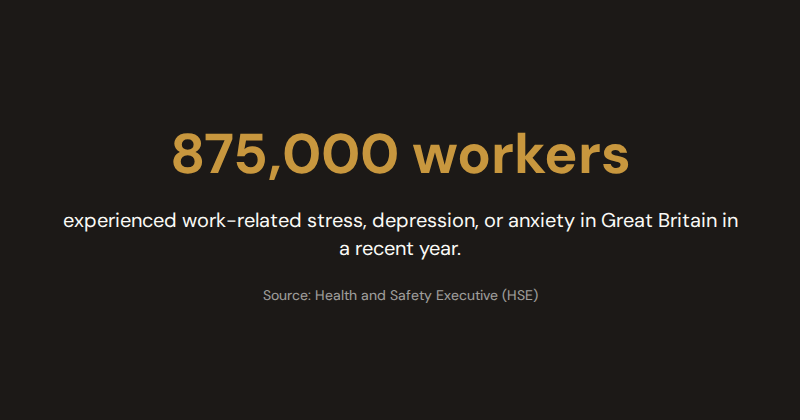
At the same time, the Health and Safety Executive (HSE) reports around 875,000 workers experiencing work-related stress, depression, or anxiety in Great Britain in a recent reporting year. If your head feels overloaded, you are not alone.
That does not mean you are powerless. It means your mind is doing what overloaded minds do: scanning, predicting, rehearsing, and trying to protect you.
The trick is teaching it a better job description.
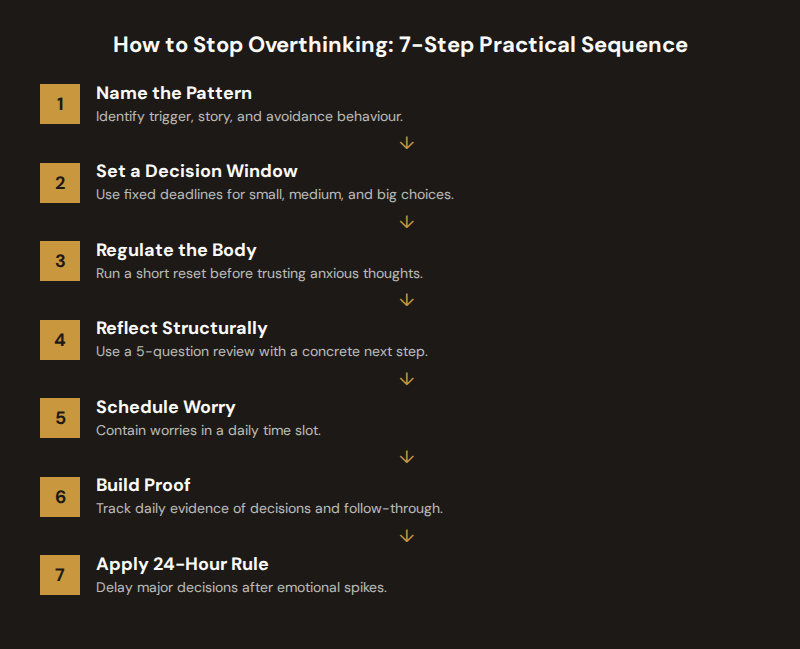
Step 1: Name the overthinking pattern in plain English
If you want to learn how to stop overthinking, start with language.
Most people use vague labels:
- "I'm spiralling"
- "My head is gone"
- "I'm a mess"
Those labels feel true in the moment, but they give you nothing to work with.
Use this instead:
- What is the trigger? (e.g. "I got a short email from my manager")
- What story did my mind create? (e.g. "I'm in trouble")
- What action did I avoid? (e.g. "I delayed replying all afternoon")
Write those three lines in your notes app or journal. Keep it simple.
Why this works: overthinking thrives in vagueness. Specificity weakens it.
When I first got sober, this was a massive shift for me. Instead of "I'm all over the place", I learned to say: "Trigger: silence from someone. Story: they are disappointed in me. Avoidance: I don't call." Once I could see the sequence, I could interrupt it.
Micro-tool: the 90-second dump
Set a timer for 90 seconds and brain-dump every thought on paper. No editing.
Then circle only two things:
- one fact
- one next action
Everything else is noise for now.
Step 2: Use a decision window (not endless analysis)
Overthinking often looks intelligent, but it is usually delayed fear.
You tell yourself you are being thorough. In reality, you are often trying to avoid the discomfort of commitment.
If you genuinely want how to stop overthinking to become practical, set a decision window:
- Small decisions (text, email, meal, workout time): 2-10 minutes
- Medium decisions (plans, spending, scheduling): 24 hours
- Big decisions (job changes, relationship calls, major moves): 3-7 days
After the window closes, you choose.
Not because you have zero doubt. Because you trust action over endless rehearsal.
Decision script you can copy
"I have enough information for this level of decision. I'm choosing now, and I can adjust if needed."
That sentence stopped me from waiting for certainty that never came.
Step 3: Regulate your body before you trust your thoughts
When your nervous system is overloaded, your thoughts are less reliable.
That is why overthinking gets louder at night, after conflict, when you are tired, or when your routine is off.
So before solving the thought, settle the body.
Four-minute reset
- 60 seconds: unclench jaw, drop shoulders, loosen hands
- 90 seconds: slow breathing (in for 4, out for 6)
- 60 seconds: stand up and walk, even just around the room
- 30 seconds: ask "What matters in the next hour?"
Then act on one task.
This is basic, but it works because it brings your brain out of threat mode and back into task mode.
When I was rebuilding after drinking, I treated this like training. I did not wait until I felt calm; I practised calming on purpose. Same as fitness: reps create capacity.
If you are working on this alongside deeper stress patterns, you might also find coaching for stress useful.
Step 4: Replace rumination with structured reflection
People confuse reflection and rumination all the time.
- Reflection asks: "What happened, what did I learn, what will I do next?"
- Rumination asks: "Why am I like this?" on a loop with no action
Here is a five-line reflection framework I give clients:
- What happened? (facts only)
- What was in my control?
- What was outside my control?
- What will I repeat next time?
- What is my next concrete step?
Set a 10-minute timer. When the timer ends, move.
This matters because overthinking steals momentum. Reflection restores it.
If your loops are strongly fear-led, read anxiety coaching after this piece for extra context.
Step 5: Give worry a schedule so it stops running your day
This sounds odd, but it is one of the strongest tools for how to stop overthinking in daily life.
Create a "worry slot": 15 minutes at the same time each day.
Rules:
- Outside that slot, when worry appears, write it down and say "later"
- During the slot, review the list and sort each worry into:
- act now
- plan later
- release
Your brain learns that worry has a container. It no longer needs to interrupt you every hour to "keep you safe".
Step 6: Build evidence of your own competence
Overthinking grows when self-trust is low.
So do this daily:
The "proof list"
At the end of the day, write three things:
- One decision I made
- One difficult thing I handled
- One promise I kept
This is not ego work. It is memory correction.
Your overthinking brain remembers risk. You need a system that remembers capability.
Over time, this changes your internal dialogue from "What if I mess it up?" to "I've handled hard things before. I'll handle this too."
For mindset-specific work, mindset coach gives a deeper breakdown of identity and behaviour change.
Step 7: Use the 24-hour rule after emotional spikes
Most overthinking flare-ups follow an emotional spike:
- criticism
- rejection
- conflict
- disappointment
In those windows, avoid big decisions unless truly urgent.
Apply the 24-hour rule:
- no major messages
- no relationship ultimatums
- no quitting decisions
- no "I need to sort my entire life tonight"
Do your regulation, sleep, review in the morning, then decide.
I cannot count how many unnecessary problems this one rule has prevented.
Three scripts to use when your head starts spinning
- "I do not need a perfect decision, only a responsible next one."
- "This thought is loud, not necessarily true."
- "My job is action in the next hour, not certainty for the next year."
If you repeat those scripts while applying the tools above, your nervous system starts to associate uncertainty with action rather than paralysis.
A practical weekly plan (so this actually sticks)
If you are serious about how to stop overthinking, use this for seven days:
Daily
- morning: decision windows for top 3 choices
- midday: 4-minute body reset
- evening: proof list (3 lines)
Three times weekly
- 10-minute structured reflection
- review your repeated triggers
Once weekly
- choose one overthinking pattern to work on next week
Do not try to fix everything at once. Choose one loop and train one better response.
Common mistakes people make
-
Trying to think their way out of overthinking
- You need behavioural interruption, not better arguments.
-
Waiting to feel ready
- Action creates readiness more often than readiness creates action.
-
Using perfection as a safety strategy
- Perfect choices do not exist. Timely, aligned choices do.
-
Ignoring sleep and routine
- Tired brains catastrophise.
-
Doing it alone for too long
- Patterns that took years to build often need structure and accountability to unwind.
When overthinking is affecting work and relationships
Overthinking is not "just in your head". It has real consequences:
- delayed responses
- missed opportunities
- avoidance of hard conversations
- emotional withdrawal
- exhaustion from constant mental rehearsal
If that sounds familiar, the solution is not to "be stronger". It is to build better systems and practise them until they are automatic.
And if your overthinking is closely linked with anxiety loops, start with this companion guide: how to deal with anxiety.
Frequently asked questions
What causes overthinking in the first place?
Overthinking usually comes from fear, uncertainty, and low self-trust. Your brain is trying to protect you from pain by running constant simulations, but that creates paralysis rather than progress.
How long does it take to stop overthinking?
You can feel early changes within one to two weeks if you apply tools daily. Lasting change usually comes from six to twelve weeks of consistent practice.
Is overthinking the same as anxiety?
Not exactly. Overthinking is a cognitive pattern; anxiety is a broader emotional and physiological experience. They often feed each other.
What is the fastest technique for an overthinking spiral?
Use the 4-minute reset: body relaxation, slower breathing, brief movement, then one concrete action. It interrupts the spiral quickly.
Can coaching help with overthinking?
Yes, especially when overthinking has become your default under pressure. Good coaching gives you structure, accountability, and practical tools that are tailored to your patterns.
Working with a coach
If you have tried to handle this alone and still feel stuck in mental loops, coaching can help you build practical systems and follow-through. If you want support, you can book an initial session.