By Alistair Johnstone
If you have searched for a mindset coach UK, there is a good chance you are not lazy, broken, or lacking ambition.
You are probably exhausted by the stop-start cycle. You know what to do. You even start strong. Then life gets noisy, your standards slip, and suddenly you are back at square one wondering why discipline felt so easy for ten days and impossible by week four.
I work with people in exactly that gap.
This approach is not there to hand out slogans or tell you to "manifest" your way into a better life. A proper coach helps you build the internal structure to do what matters when motivation is low, pressure is high, and no one is clapping.
Key Takeaways
- Coaching helps you train behaviour, not just "think positively"
- Real coaching is built on habits, routines, accountability, and honest reflection
- A coach focused on mindset should challenge you clearly, not flatter you vaguely
- Coaching is future-focused and action-based; it is different from therapy
- Lasting confidence is built through repeated follow-through, not one emotional breakthrough
What Is a Mindset Coach?
A coach focused on mindset helps you change the way you interpret pressure, setbacks, success, and responsibility, then ties this work to practical action.
In plain terms, this approach helps you:
- notice the thought patterns that keep you stuck
- separate facts from emotional stories
- replace avoidance with clear decisions
- create routines that keep momentum alive
- stay accountable when the old excuses return
That is why people often search for this kind of support after trying everything else first. Books can inspire you. Podcasts can teach you. But neither can look you in the eye and say, "You said this mattered. Why did you abandon it on Thursday?"
That direct conversation is where real change usually starts.
If mental loops are your main blocker, read how to stop overthinking for practical interruption tools.
Mindset Is Not Positive Thinking
One of the biggest myths in this space is that this kind of work is just optimism with better branding.
It is not.
If you are grieving, overwhelmed, or frustrated, the answer is not to smile harder. The answer is to be honest about your current standards, your current habits, and your current reality.
In my approach, mindset is practical mental discipline:
- Awareness - spotting the narrative running in your head
- Responsibility - owning your next move without self-pity
- Execution - doing the small things repeatedly until identity shifts
That is what separates sustainable change from temporary motivation.
Why Coaching Matters Right Now in the UK
The demand for coaching has grown for a reason. According to the ICF Global Coaching Study, the coaching profession in the UK has continued to expand, reflecting stronger demand for structured support and accountability.
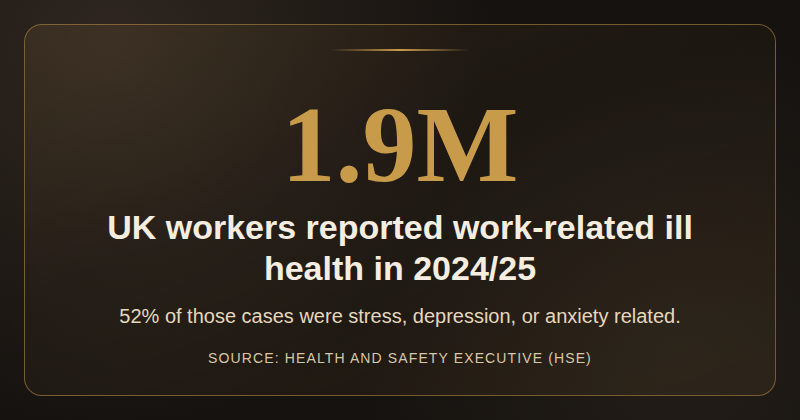
At the same time, pressure in daily life is not easing. The Health and Safety Executive reports that 1.9 million workers were suffering from work-related ill health in 2024/25, with 52% linked to stress, depression, or anxiety. If your head is constantly full and your nervous system is always on, mindset is no longer a luxury skill.
Social disconnection plays a part too. The Campaign to End Loneliness reports that 7.1% of people in Great Britain experience chronic loneliness (feeling lonely often or always). Isolation erodes standards quietly. Without challenge, accountability, and perspective, it is easy to normalise drift.
This is where working with a coach can make a real difference: not by fixing your life for you, but by rebuilding your relationship with discomfort, action, and self-respect.
Fixed Mindset vs Growth Mindset (Without the Cliches)
You have probably heard this before: fixed mindset bad, growth mindset good. True enough, but too simplistic to be useful.
Here is how it shows up in real life:
-
Fixed pattern: "If I am struggling, I must be failing."
-
Growth pattern: "Struggle is feedback. What skill is this exposing?"
-
Fixed pattern: "I missed three days, so I have blown it."
-
Growth pattern: "I missed three days. Reset now."
-
Fixed pattern: "People like me never stay consistent."
-
Growth pattern: "Consistency is built, not inherited."
The point is not to become endlessly cheerful. The point is to become adaptable. This approach helps you catch fixed-pattern thinking early, before it turns into self-sabotage.
What Happens in Coaching Sessions?
People often expect either a lecture or a pep talk. Good coaching is neither.
A session with me is structured, direct, and practical. We usually work through:
1) Current reality
What are the facts this week? Not the ideal plan, not the story, the facts. What did you commit to? What did you do? Where did you avoid discomfort?
2) Pattern recognition
We identify the exact pattern behind the stall:
- perfectionism disguised as high standards
- procrastination disguised as "research"
- people-pleasing disguised as kindness
- emotional reactivity disguised as "just being honest"
3) Behavioural adjustment
We set a narrow, clear intervention for the next seven days. Not twenty goals. Usually one or two commitments with very specific conditions.
4) Accountability loop
You report back. We do not perform. We review. If it worked, we reinforce it. If it failed, we diagnose and adjust.
That loop is where confidence is built.
If you want this kind of structure, you can look at my mental health coaching and personal development coaching pages for how I run ongoing support.
Coaching vs Therapy: The Straight Answer
This question comes up all the time.
Therapy and coaching can both be valuable, but they are not the same tool.
- Therapy often explores emotional pain, trauma, and psychological healing
- Coaching focuses on present decisions, future behaviour, and practical execution
In short: therapy often asks "what happened and how has it affected you?" Coaching asks "what are you choosing now, and what will you do next?"
If you want more context first, read what is life coaching, which breaks down the wider coaching landscape clearly. For broader growth strategy, personal development coach is also worth reading.
My Approach: Sobriety, Structure, and Brutal Honesty
I do not coach from theory alone.
My own life changed when I stopped negotiating with myself.
Getting sober forced me to face a truth that many people avoid for years: the process is not built in moments of inspiration. It is built in ordinary moments where you either honour your standards or betray them.
No one sees those moments. They still define your life.
That is why my coaching is built around:
- non-negotiable basics (sleep, movement, planning, boundaries)
- daily proof of self-trust (small promises kept)
- honest self-examination without drama
- accountability that is direct but respectful
If you are looking for someone to tell you that everything is perfect as it is, I am not your coach.
If you are ready to become the sort of person who follows through under pressure, I can help.
Real-World Examples of Coaching in Practice
Example 1: The overthinker who never ships
A client in Edinburgh had brilliant ideas and zero follow-through. Every plan was "not quite ready". Underneath it was fear of judgement.
We shifted from outcome obsession to execution reps: publish one imperfect piece weekly, no exceptions, no edits after posting. Six weeks later, output became normal. Confidence followed behaviour, not the other way round.
Example 2: The high achiever running on fumes
Another client looked successful externally but was internally chaotic: no routines, no recovery, no boundaries. We stripped the system back to three anchors each day: morning planning, midday reset walk, evening review. Within a month, decision fatigue dropped and consistency improved. If this sounds familiar, burnout coaching goes deeper on recovery plus prevention.
For context on that accountability piece, read the power of accountability.
Example 3: The people-pleaser who abandoned personal goals
A client kept saying yes to everything and resented everyone for it. We used a simple weekly boundary script and one rule: no new commitments without a 24-hour pause. Her confidence rose because her actions finally matched her values.
If that sounds familiar, what is lifestyle coaching is worth reading next.
How to Choose the Right Coach in the UK
The UK coaching space is growing, which is good, but it also means quality varies.
When evaluating a coach, look for:
- Clear method - can they explain exactly how sessions work?
- Behaviour focus - do they tie mindset to action and routines?
- Track record - can they point to real outcomes and long-term client change?
- Honesty - do they challenge you, or just keep you comfortable?
- Fit - do you feel respected and understood, even when challenged?
A strong coach should give you practical structure, not dependency.
What Results Can You Expect?
This approach is not magic, but it is powerful when done properly.
Most clients notice early wins in:
- clearer decision-making
- reduced procrastination
- better emotional regulation under pressure
- stronger boundaries
- improved follow-through on goals
Longer term, the deeper result is identity-level:
You stop seeing yourself as someone who "tries" and start becoming someone who executes consistently.
That shift changes career performance, relationships, health behaviours, and self-respect.
Sport England reports 63.7% of adults in England meet activity guidelines (around 30 million adults) (Sport England).
Is This Right for You?
It usually is if any of these sound familiar:
- You are capable but inconsistent
- You keep restarting instead of sustaining
- You avoid difficult conversations and decisions
- You are successful on paper but mentally scattered
- You are ready for honest feedback, not motivation theatre
If you are based locally, my Edinburgh coaching page explains how I work with clients in person and online.
And if you want to know more about me before you decide, visit about. If you are ready to talk, start at contact.
A final thought: searching for this support is not weakness. It is usually the first mature decision in a long time. You are saying, "I am done drifting. I am ready to train how I think, how I act, and how I live."
That decision matters more than people realise.
Frequently Asked Questions
What does this support actually do?
Working with a coach helps you identify unhelpful thought patterns, build better behavioural systems, and stay accountable to the standards you set. The goal is practical change, not temporary motivation.
Is coaching the same as positive thinking?
No. Useful coaching is grounded in realism, responsibility, and execution. It is not about pretending everything is fine; it is about responding better when things are not fine.
What is the difference between coaching and therapy?
Therapy generally explores healing and psychological wellbeing in depth, while this approach is action-focused and future-facing. Coaching concentrates on habits, routines, decisions, and follow-through.
How long does this take to work?
Many people notice stronger clarity and consistency in the first month. Lasting change usually comes from sustained repetition over several months, especially when accountability is built in.
How do I choose the right coach in the UK?
Choose someone with a clear method, proven client outcomes, strong personal integrity, and a coaching style that challenges you constructively. You want substance, not slogans.
If this resonates, the next step is simple: book your initial session. One honest conversation can reveal exactly where you are stuck and what to do next.