By Alistair Johnstone
If you searched how to cope with loneliness, you are probably tired of generic advice like “just put yourself out there”.
Loneliness is not fixed by one brave evening out. It usually shifts through repeated, practical moves that rebuild trust, rhythm, and belonging.
Getting sober was the loneliest thing I have ever done. Everyone celebrates when you quit. Nobody tells you about the silence that follows — the social spaces you no longer fit, the numbers in your phone you stop calling, the hours that feel too quiet. I had to build a life that could hold that silence without collapsing into it.
That is what this guide is for.
Key Takeaways
- If you are searching how to cope with loneliness, begin with structure, not self-blame
- Loneliness improves with repeated contact, not one-off social effort
- Emotional safety matters more than social volume
- Daily micro-actions create connection momentum
- Honest routines work better than forced positivity
What Loneliness Actually Does to You
Loneliness is not just “being alone”. It is the felt gap between the connection you need and the connection you have.
It affects your thinking, your energy, and your confidence:
- You overanalyse messages
- You assume rejection before it happens
- You withdraw to protect yourself
- You feel flat even when people are around you
This is more common than most people admit. The Campaign to End Loneliness highlights national survey data showing that around 10% of adults aged 16-29 report feeling lonely often or always, compared with around 3% of people aged 70+. Loneliness is not only an older-age issue; it cuts across life stages.
Pressure compounds the problem. The HSE reports that 52% of all work-related ill health cases are linked to stress, depression, or anxiety, which often leaves people emotionally exhausted and less able to maintain relationships.
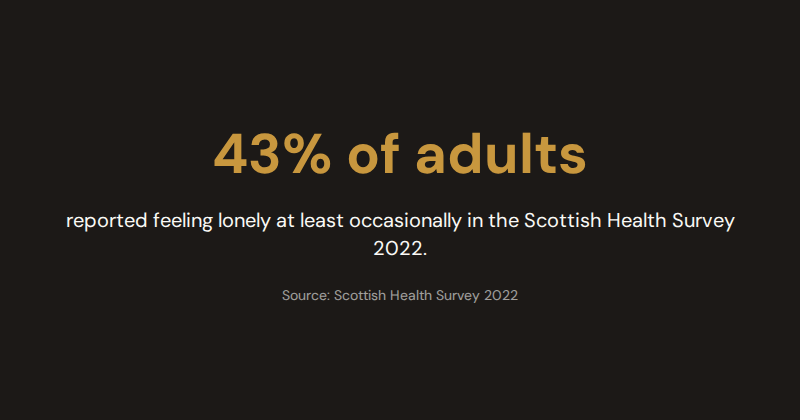
And social connection has clear wellbeing links. The Scottish Health Survey 2022 reported that 43% of adults felt lonely at least occasionally, underlining how common this experience is.
Step 1: Stabilise Your Day Before You Rebuild Your Social Life
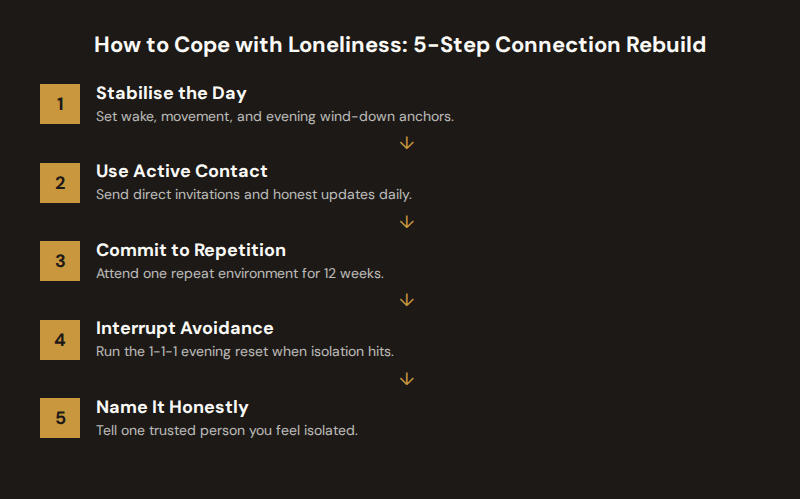
If you want a realistic answer to how to cope with loneliness, start with your daily baseline.
When people feel lonely, they often wait for someone else to change how they feel. But your nervous system needs internal steadiness before social rebuilding feels possible.
The 3-Anchor Day
Pick three fixed anchors for the next 14 days:
- Wake time (same window each day)
- Movement block (20-30 minutes)
- Evening wind-down (no phone for last 30 minutes)
This does two things:
- reduces emotional volatility
- creates predictable energy for social effort
Loneliness feels louder in unstructured time. Anchors reduce that amplification.
Step 2: Replace Passive Isolation with Active Contact
Most lonely people are not doing nothing — they are doing low-return contact:
- endless scrolling
- sending messages without proposing plans
- waiting for others to initiate
Active contact is different. It is clear, specific, and time-bound.
The Daily Contact Rule
For 21 days:
- Send one direct message with a clear invitation
- Ask one real question (not “how are you?”)
- Share one honest update about your week
Examples:
- “Fancy a 30-minute coffee this Thursday at 7?”
- “I have had a rough week and could do with a walk — are you free Saturday?”
- “I am trying to get back into regular contact; want to restart monthly catch-ups?”
This is uncomfortable at first, but it is how isolation loops break.
Step 3: Build Belonging Through Repeat Environments
If you are learning how to cope with loneliness, this is crucial: one-off events rarely solve it.
Belonging forms through repetition.
You need environments where the same people show up consistently:
- regular gym class
- local running group
- volunteering slot
- recovery group
- weekly hobby session
The 12-Week Belonging Plan
Choose one repeat environment and commit for 12 weeks before judging whether it is “working”.
Week 1-3: you feel awkward. Week 4-7: faces become familiar. Week 8-12: conversations deepen.
Most people quit in week 2 and then tell themselves they cannot connect. The issue is often not your ability; it is your timescale.
When I first rebuilt my social life after getting sober, I had to sit through a lot of quiet evenings and clumsy small talk. It was not glamorous. It was consistent. That consistency made the difference.
Step 4: Learn the Difference Between Solitude and Avoidance
Healthy solitude restores you. Avoidance isolates you.
Use this quick check:
- After solitude, do I feel clearer? (healthy)
- After solitude, do I feel smaller and more fearful? (avoidance)
If it is avoidance, add one social action the same day.
The 1-1-1 Reset for Lonely Evenings
When evenings are hardest, do this:
- 1 body action — walk, stretch, shower
- 1 connection action — message/call someone safe
- 1 meaning action — read, journal, or prepare tomorrow intentionally
You are training your system not to collapse into passivity.
Step 5: Speak Honestly to One Person
A lot of people asking how to cope with loneliness are carrying secret shame about it.
Shame grows in silence. Loneliness softens when named.
Choose one person and say something direct:
“I have been feeling quite isolated lately. I am trying to change that. Could we catch up this week?”
You do not need a dramatic speech. You need one honest sentence.
In my experience, this one move often creates more real connection than months of performative busyness.
A Practical Weekly Framework
Use this for the next month:
Monday: Plan Contact
- schedule two social invitations
- choose one repeat environment session
Tuesday-Thursday: Execute
- one daily contact action
- one physical movement block
Friday: Review
- what helped connection?
- what fed avoidance?
Weekend: Depth Over Volume
- prioritise one meaningful conversation
- reduce shallow social noise
If your loneliness links to relationship recovery, rebuild after a toxic relationship is a useful companion read.
If you want broader lifestyle structure, what is lifestyle coaching explains the practical framework behind routine-led change.
For male-specific patterns around isolation and emotional shutdown, life coaching for men goes deeper.
You may also find how to improve your mental health helpful, because regulation and social connection are deeply linked.
Common Mistakes That Keep Loneliness in Place
- Waiting to “feel social” before initiating contact
- Treating social media as a replacement for conversation
- Expecting immediate closeness in new groups
- Hiding loneliness due to embarrassment
- Quitting routines before trust has time to form
None of these make you weak. They make you human. The point is to notice the pattern and interrupt it early.
What Progress Actually Looks Like
Progress is rarely dramatic. It looks like:
- one less isolated evening
- one honest message sent
- one weekly group you keep attending
- one friendship getting more real
If you searched how to cope with loneliness, do not measure success by never feeling lonely again. Measure it by how quickly you return to connection when loneliness appears.
That is resilience.
The Loneliness Loop (and How to Interrupt It)
Most people caught in loneliness are stuck in a loop:
- Feel lonely
- Assume reaching out will be awkward
- Avoid contact
- Feel more disconnected
- Lose confidence in social effort
To interrupt the loop, you need a behavioural interrupt at step 2.
Use this sentence when hesitation appears:
"I am not deciding whether they will respond. I am deciding whether I will act in line with the life I want."
Then send the message.
This is a major part of practical work around how to cope with loneliness: separating outcome control from action control.
Rebuilding Trust After Social Setbacks
For many people, loneliness is not just lack of contact. It is also loss of trust after disappointment, conflict, or major life transition.
If that is you, use a paced trust model:
Stage 1: Low-risk contact
- short interactions
- predictable settings
- clear start and finish times
Stage 2: Moderate vulnerability
- share one honest challenge
- ask one personal question
- notice how the other person handles your honesty
Stage 3: Deeper connection
- regular check-ins
- mutual support
- consistent follow-through
Trust should be built by evidence over time, not rushed because you feel lonely today.
A Practical Evening Plan for Quiet Nights
Evenings are where loneliness often feels sharpest. Build a standard evening plan so silence does not automatically become rumination.
The 90-Minute Evening Framework
Block 1 (30 min): physical reset
- walk, mobility, or light workout
Block 2 (30 min): relational action
- message someone, call someone, or attend a group session
Block 3 (30 min): meaningful solo activity
- reading, journalling, planning, or skill building
This creates a balanced mix of regulation, connection, and purpose.
If you are using this regularly, track your evenings on a simple score:
- 0 = isolated and passive
- 1 = one active step
- 2 = two active steps
- 3 = full framework completed
Aim for consistency, not perfection.
How to Cope with Loneliness at Work
People often overlook workplace loneliness, especially in remote or high-pressure roles.
If this is part of your experience:
- schedule one non-transactional conversation each week
- join one recurring cross-team touchpoint
- ask for clearer role expectations to reduce isolation-by-confusion
Feeling disconnected at work can quietly affect confidence and performance.
If work pressure and isolation are linked for you, how to deal with stress at work is a practical next read.
A 4-Week Social Rebuild Challenge
If you want a structured answer to how to cope with loneliness, follow this challenge:
Week 1: Reconnect
- message three people
- schedule one catch-up
Week 2: Re-enter
- attend one repeat environment twice
- stay for the full session both times
Week 3: Deepen
- have one honest conversation
- share one real challenge instead of surface updates
Week 4: Stabilise
- set one recurring social commitment for next month
- keep your evening framework at least four nights per week
By week four, most people report more stability and less emotional reactivity around social uncertainty.
If You Feel You Have "Forgotten" How to Connect
You have not forgotten. You are out of practice.
Connection is a skill set:
- asking better questions
- listening properly
- sharing honestly without oversharing
- following up consistently
Skills return with reps.
And if you are still hearing "I should not feel like this" in your head, replace it with: "This is a common human experience, and I am taking practical steps out of it." That one sentence removes a lot of unnecessary shame.
You do not need to become a different person to feel less lonely. You need repeated actions that bring you closer to people and closer to your own life.
Frequently Asked Questions
What is the first thing to do when loneliness feels overwhelming?
Start with one grounding action: get outside, move your body, and message one safe person. Small actions reduce emotional intensity and restore momentum.
How do I cope with loneliness if I have people around me?
Focus on depth over quantity. Emotional loneliness often improves when you have one honest conversation, not more surface-level contact.
Can routines actually reduce loneliness?
Yes. Regular routines create predictable contact points and reduce isolation loops. Repeated shared environments make meaningful connection more likely.
How long does it take to feel less lonely?
Most people feel a small shift in one to two weeks when they take daily social actions. Lasting change usually comes from consistent effort over several months.
What if I feel embarrassed admitting I am lonely?
That feeling is common. Naming loneliness is often the turning point because it moves you from silent suffering to practical action.
Working with a coach
If you want support rebuilding structure and connection in a way that fits your real life, you can reach out here. We can map your current patterns and create a practical plan you can actually stick to.