By Alistair Johnstone
If you searched how to improve mental health, you are probably looking for practical changes you can make this week, not abstract advice.
That is the right instinct.
Mental health is not one big decision. It is fifty small ones you make every day — how you sleep, how you speak to yourself, who you spend time with, and whether your schedule supports recovery or drains it.
This guide gives you a simple framework to improve your mental health without pretending life is easy.
Key Takeaways
- If you are searching how to improve mental health, focus on repeatable daily behaviours
- Small actions done consistently outperform occasional dramatic resets
- Movement, sleep, and social connection are foundational mental health levers
- Boundaries reduce emotional overload faster than positive thinking alone
- Weekly review helps you keep what works and drop what does not
Why Small Changes Work Better Than Big Promises
Big promises feel good in the moment and collapse under pressure. Small systems survive ordinary life.
That is why this article focuses on daily structure.
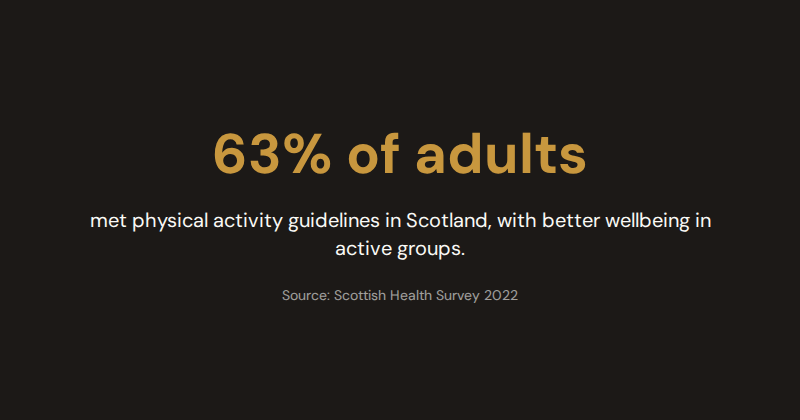
The Scottish Health Survey 2022 reports that 63% of adults met physical activity guidelines, and more active groups report stronger wellbeing outcomes than inactive groups. This is not about perfection; it is about frequency.
At a workforce level, the challenge is clear. The HSE reports that 52% of work-related ill health cases are linked to stress, depression, or anxiety in Great Britain.
And social disconnection still matters. The Campaign to End Loneliness reports that 7.1% of people in Great Britain experience chronic loneliness (feeling lonely often or always), which is strongly linked to poorer mental wellbeing.
Step 1: Build a Mental Health Baseline
If you want a practical answer to how to improve mental health, start with a baseline that is easy to keep.
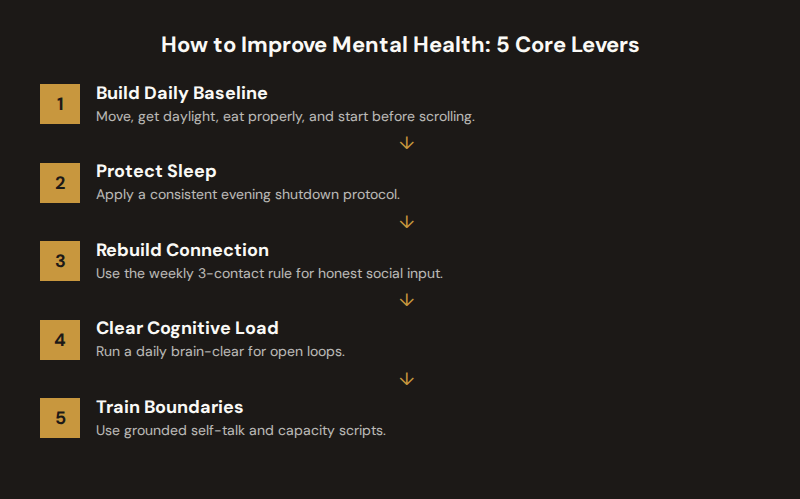
Use this daily minimum:
- Move for 20 minutes
- Get outside in daylight
- Eat one proper meal without rushing
- Do one meaningful task before scrolling
This is not a complete life overhaul. It is a stabilisation system.
Why this works
Your brain and body respond to rhythm. A predictable baseline reduces emotional volatility and increases your sense of control.
Step 2: Protect Your Sleep Like a Performance Asset
Most people trying to work out how to improve mental health underestimate sleep.
Poor sleep worsens anxiety, irritability, and concentration. Better sleep improves emotional regulation and recovery.
The Evening Shutdown Protocol
For the next 14 nights:
- no heavy work in final hour
- no doom scrolling in bed
- set tomorrow’s top task before you sleep
- keep wake time within a consistent window
You do not need perfect sleep hygiene. You need fewer self-inflicted disruptions.
Step 3: Rebuild Connection in Small, Honest Ways
Mental health deteriorates quickly when you stay socially disconnected for too long.
You do not need ten new friends. You need real contact.
The 3-Contact Rule (Weekly)
Each week:
- one check-in message to someone you trust
- one in-person interaction (walk, coffee, class)
- one honest conversation where you do not perform “I am fine”
This is especially useful if you feel flat, withdrawn, or emotionally distant.
If loneliness is a key issue, read how to cope with loneliness next.
Step 4: Reduce Cognitive Overload
If your head feels noisy all day, your mental health will feel fragile.
Cognitive overload often comes from:
- too many open loops
- too many notifications
- too many unmade decisions
The Daily Brain Clear (15 minutes)
At the end of each workday:
- write down unfinished tasks
- choose tomorrow’s top three
- clear one admin burden now
This lowers background stress and helps your mind switch off at night.
Step 5: Train Your Self-Talk and Boundaries
A lot of people searching how to improve mental health are hard on themselves in ways they would never be hard on a friend.
Two practical shifts:
1) Self-Talk Reframe
Replace:
- “I am failing”
With:
- “I am overloaded; what is the next useful step?”
2) Boundary Script
Use:
“I cannot take that on this week without dropping something important. If this is a priority, tell me what should move.”
Boundaries are preventative mental health care in plain language.
A 30-Day Mental Health Plan
If you want to embed how to improve mental health into your life, use this sequence:
Week 1: Stabilise
- implement daily baseline
- begin evening shutdown protocol
Week 2: Connect
- run 3-contact rule
- reduce one isolation habit
Week 3: Simplify
- daily brain clear
- remove one major friction source
Week 4: Consolidate
- review what improved mood and energy
- keep top five behaviours
- schedule them into next month
Consistency is the intervention.
Common Mistakes That Stall Progress
- Changing everything at once
- Ignoring sleep while chasing productivity
- Treating social connection as optional
- Carrying work stress into evenings unchecked
- Measuring success only by “feeling great”
Success is often quieter: more stable mood, better sleep, fewer spirals, clearer decisions.
Where This Fits with Broader Support
If you are comparing options, coaching vs therapy explains the difference in plain terms.
If your focus is lifestyle-led wellbeing, what is lifestyle coaching and wellness coach show how practical structure can support long-term change.
If work pressure is your main trigger, how to deal with stress at work is your next step.
Final Reminder
If you came here searching how to improve mental health, do not wait for perfect conditions.
Pick three actions from this page and start today:
- movement
- sleep boundary
- one honest connection
Small changes made daily are how lasting improvement happens.
The Four Pillars Model (Simple and Sustainable)
If you want one clear framework for how to improve mental health, use these four pillars:
- Physiology — sleep, movement, nutrition, daylight
- Psychology — self-talk, perspective, emotional literacy
- Relationships — support, honesty, boundaries
- Structure — routines, priorities, recovery windows
You do not need to optimise all four at once. Start with one behaviour in each pillar and repeat.
Example Weekly Setup
- Physiology: 20-minute daily walk
- Psychology: 5-minute evening reflection
- Relationships: one meaningful conversation each week
- Structure: fixed daily shutdown routine
This creates balanced progress and reduces the chance of over-focusing one area while neglecting the rest.
A Better Response to Bad Mental Health Days
Bad days are part of real life. Your system needs a low-day protocol.
Low-Day Protocol
When you feel flat, anxious, or irritable:
- reduce expectations to minimum baselines
- complete one body action
- complete one practical task
- send one honest message to a trusted person
This stops a difficult day becoming a difficult week.
The 10-10-10 Reflection Tool
Mental distress often narrows your time horizon. Everything feels urgent and permanent.
Use this reflection:
- How will this feel in 10 hours?
- How will this matter in 10 days?
- How will I see this in 10 months?
It helps your mind shift from panic framing to perspective framing.
Mental Health and Digital Load
Digital overload quietly damages wellbeing.
If you are serious about how to improve mental health, create two digital boundaries:
- no social scrolling before first meaningful action
- no algorithm feeds in final 30 minutes of the day
This single change often improves mood stability and sleep quality within days.
Food, Caffeine, and Mood Stability
You do not need a perfect diet. You need fewer avoidable spikes and crashes.
Practical basics:
- eat at regular intervals
- include protein/fibre in first proper meal
- avoid late-day caffeine overload
- stay hydrated throughout work blocks
Stable blood sugar and hydration do not solve everything, but they reduce unnecessary emotional volatility.
How to Improve Mental Health in High-Pressure Work Periods
During intense work seasons, simplify your expectations:
- protect sleep window first
- keep one daily movement action
- maintain one social connection point
- run daily brain clear before bed
Do not try to win every category. Protect the fundamentals.
If work pressure is dominating your wellbeing, practical workload tools become essential.
60-Day Progress Markers
How do you know this is working?
Look for:
- more stable mood across the week
- fewer emotional spikes after work
- better sleep continuity
- less avoidance of difficult tasks
- stronger follow-through on basic routines
That is real progress, even if life is still busy.
And if confidence is part of your mental health picture, confidence-building habits can help you reinforce self-trust while your baseline improves.
Sustainable wellbeing is not dramatic. It is repeatable.
Keep a "What Helps" List
When mental health dips, people often forget what already works for them.
Create a short list on your phone called What Helps and include 8-12 actions that reliably steady you, for example:
- 20-minute walk
- shower and clean clothes
- voice note to a trusted person
- journalling for 10 minutes
- preparing one decent meal
When your head is noisy, choose one action from the list and do it immediately. This removes decision fatigue and keeps you connected to proven tools in the exact moments you need them.
It sounds simple because it is. Simple, repeated actions are often the strongest answer to long-term mental wellbeing.
Frequently Asked Questions
What is the best daily habit for better mental health?
Consistency matters more than one perfect habit. A daily mix of movement, sleep routine, and one meaningful connection tends to deliver the strongest results.
How quickly can mental health improve with small changes?
Many people notice initial improvements in one to three weeks. Durable gains usually come from repeating those small changes over months.
Can physical activity genuinely improve mental wellbeing?
Yes. Population data consistently links regular physical activity with better mood, lower distress, and stronger overall wellbeing.
How do I improve mental health when I am busy?
Use minimum baselines: short movement, fixed wind-down, and one intentional check-in daily. Small routines beat occasional big efforts.
What should I stop doing first?
Reduce habits that amplify stress without return, such as late-night doom scrolling, overcommitting, and unstructured work carry-over into evenings.
Working with a coach
If you want support turning these ideas into a practical weekly structure, you can get in touch here. We can design a plan that matches your workload, habits, and recovery needs.