By Alistair Johnstone
If you searched how to find motivation, you are probably not lazy. You are likely overloaded, disappointed, or stuck in a start-stop loop that has worn down your trust in yourself.
I have seen that loop in clients, and I have lived it myself. I do not wait for motivation. I set my alarm for 3:45am and go anyway. That is not motivation — that is structure.
The good news is that motivation can be rebuilt. Not by hype. By design.
Key Takeaways
- If you are searching how to find motivation, begin with routine architecture
- Motivation follows action more often than action follows motivation
- Keep tasks tiny enough to start on your worst day
- Accountability and visibility increase follow-through
- Physical movement supports mental momentum and reduces inertia
Why You Feel Unmotivated (Even If You Care)
Most people think low motivation means low ambition. Usually, it means one of three things:
- Your goals are unclear
- Your routine has too much friction
- Your nervous system is exhausted
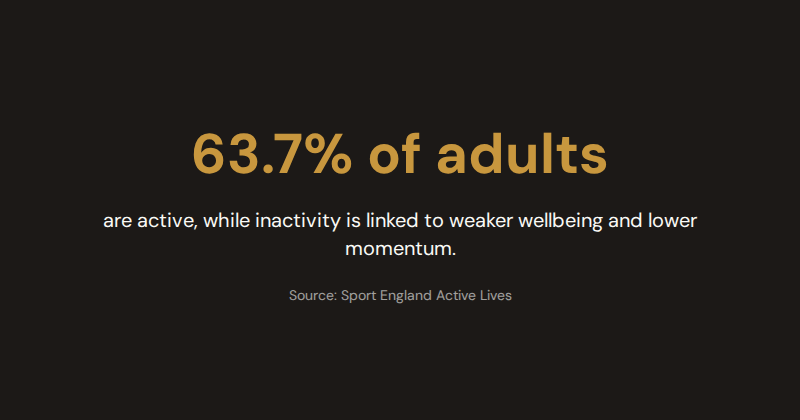
That last part matters. Sport England Active Lives reports that 63.7% of adults are active while 22.4% are inactive, and active adults consistently report stronger wellbeing scores. Motivation is not just mindset; it is state management.
The wider pressure context is real too. The HSE reports that 16.4 million working days were lost due to stress, depression, or anxiety in 2023/24, which drains the energy required for focused action.
And change tends to stick better with support. The ICF Consumer Awareness Study found that 72% of coaching clients improved communication skills, a useful proxy for clearer commitments and stronger follow-through.
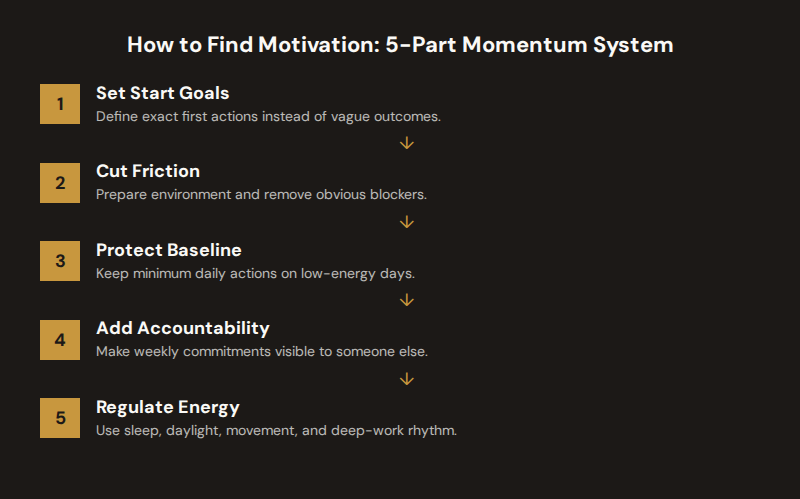
Step 1: Replace Motivation Goals with Start Goals
If you want a real answer to how to find motivation, stop setting goals like:
- “Be more motivated”
- “Get my life together”
- “Be productive all day”
Set start goals instead:
- “Open the project file at 8:30am”
- “Walk outside for 15 minutes after lunch”
- “Write 150 words before checking messages”
Start goals remove ambiguity. Ambiguity kills action.
The 5-Minute Rule
For any task you are avoiding:
- Set a timer for five minutes
- Do only the first smallest part
- Stop if you want after five
Most days, you continue. But even if you stop, you have broken the freeze response.
Step 2: Build Low-Friction Structure
When people ask how to find motivation, they usually underestimate friction.
Friction is any tiny barrier that makes action less likely:
- trainers buried in a cupboard
- unclear task list
- no fixed work block
- notifications always on
Friction Audit Checklist
Ask these daily:
- Is my next action visible?
- Is my environment prepared?
- Is there one clear start time?
- Have I removed obvious distractions?
Then make one friction cut each day. Small reductions compound fast.
In my own routine, the night-before setup does most of the heavy lifting: clothes out, first task defined, phone out of reach, alarm set. Morning me just executes.
Step 3: Use a Non-Negotiable Baseline
Motivation collapses when you expect high output every day. Life does not work like that.
Use a minimum baseline:
- One movement action
- One priority work action
- One life admin action
On high-energy days, do more. On low-energy days, protect the baseline.
That is how consistency survives stress.
Example Baselines
- 20-minute walk
- 25-minute focused work sprint
- 10-minute planning/reset
If you keep this baseline for 30 days, your identity shifts from “I am inconsistent” to “I always do something.” That shift is motivational gold.
Step 4: Add External Accountability
Most people do better when commitments are visible.
I have watched this repeatedly in practice: the same person who delays for weeks when alone can follow through quickly when someone else is expecting an update.
You can create this without overcomplicating it:
- Share your weekly targets with one person
- Send a short Friday check-in
- Track outcomes, not excuses
If accountability is your missing ingredient, the power of accountability is worth reading next.
And if procrastination is the pattern underneath your motivation issue, how to stop procrastinating will help you target that specifically.
Step 5: Regulate Your Energy, Not Just Your Calendar
When motivation is low, your energy system is often dysregulated.
Use this daily stack:
- morning daylight exposure
- hydration before caffeine overload
- one movement block before midday
- one uninterrupted deep-work block
- fixed wind-down at night
This is not glamorous. It is effective.
Motivation is easier to access when your body has predictable rhythms.
A 21-Day Motivation Rebuild Plan
If you are serious about how to find motivation, follow this exactly:
Days 1-7: Stabilise
- choose your minimum baseline
- set one fixed start time
- run the 5-minute rule daily
Days 8-14: Expand
- add one accountability check-in
- reduce one major friction point
- increase one baseline action by 10%
Days 15-21: Consolidate
- review what worked
- keep top three habits
- remove one habit that drains energy
Do not chase perfect days. Chase repeatable days.
Common Motivation Myths (That Keep You Stuck)
-
“I need to feel ready first.” You need to start first.
-
“If I miss a day, I have failed.” Missing once is normal. Missing twice creates drift.
-
“I just need more willpower.” You usually need clearer systems.
-
“Big goals create big motivation.” Big goals can create paralysis if the first step is vague.
-
“I should be able to do this alone.” Support improves compliance for most people.
What to Do on Your Worst Days
On the days when everything feels heavy, run this emergency sequence:
- Stand up and move for five minutes
- Do one baseline task
- Message one accountability contact
- End the day with a written plan for tomorrow
That is enough.
If low motivation is linked to chronic stress and depletion, read burnout coaching and how to deal with burnout alongside this guide.
Final Prompt
If you came here searching how to find motivation, pick one action now and do it before you open another tab.
Motivation grows fastest in motion.
The Motivation Equation: Clarity x Energy x Environment
When people ask me about motivation, I usually map three factors:
- Clarity — do you know exactly what to do next?
- Energy — do you have enough physical and mental capacity to start?
- Environment — does your setup support action or distraction?
If one is weak, motivation drops. If two are weak, consistency collapses.
This gives you a practical diagnostic model for how to find motivation without making it personal.
Quick Self-Check (score 1-10)
- Clarity: ___
- Energy: ___
- Environment: ___
Any score below 6 is where to intervene first.
Motivation for Different Personality Styles
Not everyone is motivated by the same triggers.
If you are achievement-driven
Use visible scoreboards, deadlines, and measurable targets.
If you are values-driven
Tie tasks to meaning: who benefits, what matters, why now.
If you are people-driven
Use social accountability and shared progress check-ins.
If you are autonomy-driven
Design your own process with non-negotiable outcomes.
One reason people fail to sustain motivation is they copy someone else’s system instead of designing one aligned with their temperament.
A Better Approach on "Low Drive" Days
Some days are not about optimisation. They are about non-collapse.
Use a two-tier day:
Tier A (normal days)
- full baseline
- one stretch task
Tier B (low days)
- minimum baseline only
- no self-criticism for reduced load
Tier B keeps identity intact: you are still someone who follows through, even at lower volume.
This matters because repeated all-or-nothing cycles destroy trust faster than almost anything else.
How to Find Motivation When You Are Recovering from Burnout
If burnout is in the background, traditional productivity advice can backfire.
In that phase:
- focus on energy restoration first
- keep work blocks shorter
- increase recovery density across the day
- track energy trend, not just task completion
If this lands for you, pair this article with a burnout recovery plan so your system matches your current capacity.
The Weekly Motivation Review (15 Minutes)
Every Friday, answer five questions:
- Which task gave me most momentum?
- Which friction point slowed me down?
- What routine time worked best?
- Where did I break promises to myself?
- What one change will I test next week?
Motivation improves when your system evolves. This review is how you evolve it.
Build Your "No Excuses" Start Sequence
Create a short sequence that starts your day regardless of mood:
- water
- movement
- one defined task
- no social media until first action done
Keep it simple enough to run half-asleep.
This is the same principle I live by with early starts. I do not negotiate with my feelings at 3:45am. I run the sequence.
If confidence is part of your motivation challenge, how to build confidence helps you reinforce follow-through identity at the same time.
What Sustainable Motivation Looks Like
Sustainable motivation does not feel euphoric every day.
It looks like:
- fewer zero-action days
- quicker recovery after disruptions
- stronger start habits
- less time arguing with yourself
That is what you are aiming for.
If you are still searching how to find motivation, simplify your next step until it is impossible to avoid, then repeat it tomorrow.
Frequently Asked Questions
How do I find motivation when I feel nothing?
Start with structure, not emotion. Choose one tiny action at the same time each day. Repetition creates momentum before motivation appears.
Is motivation the same as discipline?
No. Motivation is a feeling that fluctuates. Discipline is a system you run regardless of mood. Long-term progress relies on discipline.
Why do I start strong and then stop?
Most people set goals that are too big, too vague, and not tied to a routine. Reduce friction and define your first action clearly.
Can physical movement improve motivation?
Yes. Regular movement improves energy, mood, and self-belief, which makes starting tasks easier and more consistent.
What should I do on days when motivation crashes?
Use a minimum baseline: one non-negotiable action that keeps your streak alive. Consistency on low days protects long-term momentum.
Working with a coach
If you want practical support building structure and staying accountable, you can contact me here. We can build a motivation system around your real schedule, not an idealised one.