By Alistair Johnstone
If you searched how to deal with burnout, you are probably beyond “take a day off” advice.
Burnout is not ordinary tiredness. It is a deeper collapse in energy, motivation, and emotional capacity that builds over time.
Burnout is not about working too hard. It is about working without structure, without boundaries, and without something solid to come back to.
That is recoverable — but not with guesswork.
Key Takeaways
- If you are searching how to deal with burnout, start with load reduction first
- Recovery works in phases: stabilise, rebuild, then protect
- Boundaries are treatment, not optional extras
- Returning too quickly is the biggest relapse risk
- Burnout prevention requires weekly systems, not occasional rest
What Burnout Looks Like in Real Life
Burnout usually shows up as a pattern:
- constant fatigue that sleep does not fix
- reduced performance and concentration
- irritability or emotional numbness
- detachment from work and people
- dread before routine tasks
It can look like laziness from the outside. It is not.
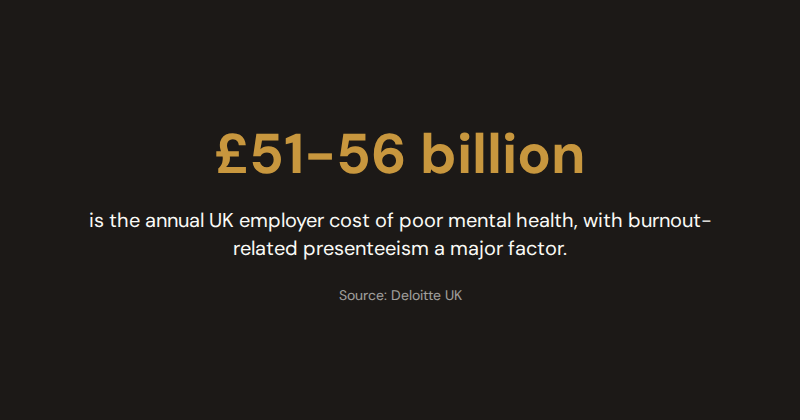
At a systems level, the cost is significant. Deloitte UK estimates poor mental health costs UK employers £51-56 billion per year, with presenteeism a major contributor. Burnout is expensive for organisations because it is expensive for humans.
The HSE likewise reports 16.4 million working days lost in 2023/24 to stress, depression, and anxiety, showing the scale of productivity and wellbeing impact.
And when burnout rises, isolation often rises too. The Campaign to End Loneliness reports 7.1% of people in Great Britain experience chronic loneliness, which can intensify exhaustion and slow recovery.
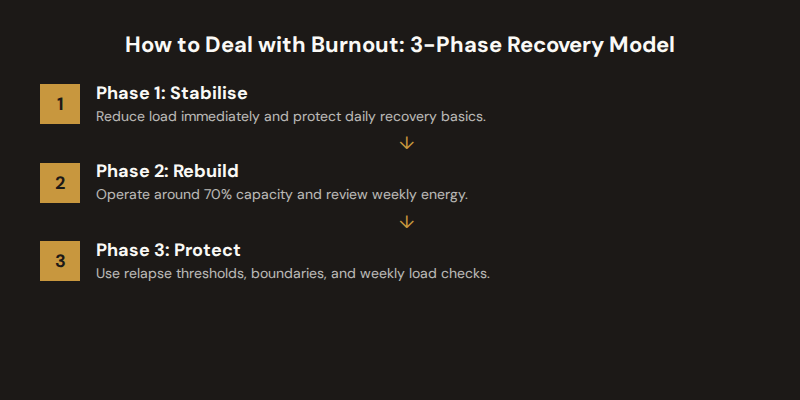
Phase 1: Stabilise (Days 1-14)
If you want a practical answer to how to deal with burnout, begin with immediate load reduction.
The Stabilisation Rule
For two weeks, keep only:
- essential work tasks
- essential life admin
- non-negotiable recovery habits
Pause optional commitments where possible.
Daily Stabilisation Stack
- fixed wake time
- 20-30 minutes of low-intensity movement
- one protected meal without multitasking
- 30-60 minute evening wind-down
This phase is not about peak performance. It is about stopping further depletion.
Phase 2: Rebuild Capacity (Weeks 3-6)
Once your baseline improves, rebuild deliberately.
The 70% Rule
Operate at roughly 70% planned capacity for a month.
Why? People recovering from burnout often over-correct by trying to prove they are “back”, then crash again.
Weekly Capacity Plan
At the start of each week:
- set top three outcomes
- schedule two recovery blocks
- define one boundary for the week
At the end of each week:
- review energy (not just output)
- identify overload triggers
- adjust next week before strain accumulates
Phase 3: Protect Against Relapse (Ongoing)
Long-term success in how to deal with burnout is protection, not heroics.
Non-Negotiable Prevention System
Keep these in place:
- Weekly workload review
- Daily shutdown routine
- Capacity-based decision-making
- Early escalation when thresholds are crossed
Burnout Thresholds to Monitor
Create red flags:
- sleep disruption for 5+ nights
- skipped recovery for 7 days
- rising cynicism and withdrawal
- sustained concentration drop
When two or more appear, intervene immediately.
Step 1: Rebuild Your Boundaries
Many people asking how to deal with burnout are not bad at work. They are bad at limits.
Use this boundary script:
“I can deliver X by Friday. If Y must be included, we need to move Z.”
It is clear, respectful, and sustainable.
Boundaries are not resistance to work. They are conditions for quality work.
Step 2: Stop Performing Recovery and Start Scheduling It
Recovery that depends on “if I have time” does not happen.
Schedule recovery like a priority:
- two movement sessions in calendar
- one social connection slot
- one low-stimulation evening block
Treat these as commitments, not rewards.
Step 3: Simplify Decisions While You Recover
Burnout worsens with decision fatigue.
For 30 days:
- reduce non-essential decisions
- standardise routines where possible
- pre-plan meals and key tasks
Less decision noise means more bandwidth for recovery.
Step 4: Reconnect with Meaning, Not Just Output
Burnout often includes meaning erosion. You are busy but disconnected.
Weekly reflection prompts:
- What mattered this week?
- What drained me unnecessarily?
- What needs to change before next week starts?
This helps you rebuild direction rather than just endurance.
Step 5: Build a Return Plan, Not a Hope Plan
If you are returning from deeper burnout, define:
- what “good enough” workload looks like
- what support you need
- what signals mean “slow down now”
Hope is not a plan. A return protocol is.
Common Mistakes in Burnout Recovery
- Trying to recover without reducing load
- Treating rest as unproductive guilt time
- Returning to full speed too quickly
- Saying yes to avoid conflict
- Ignoring early warning signs after improvement
Avoiding these five mistakes prevents most relapses.
Useful Companion Reads
If work stress is your biggest trigger, start with how to deal with stress at work.
For practical support options, coaching for stress and burnout coaching explain structure-led recovery.
If motivation has collapsed alongside burnout, how to find motivation is a helpful next step.
Final Recovery Prompt
If you came here searching how to deal with burnout, pick one action from each phase now:
- one load reduction
- one recovery block
- one protection boundary
Then repeat tomorrow.
Recovery is built through rhythm.
Burnout by Type: Know What You Are Recovering From
People use the word burnout for different patterns. Identifying your pattern improves recovery speed.
1) Overload burnout
Too much work for too long. Main intervention: reduce volume and improve prioritisation.
2) Friction burnout
Not just too much work, but too much pointless work (meetings, rework, unclear decisions). Main intervention: system redesign.
3) Value-mismatch burnout
You are producing output that feels disconnected from what matters to you. Main intervention: role clarity and meaning repair.
Many people have a mix of all three.
The Energy Budget Method
If you are trying to apply how to deal with burnout in daily life, start tracking energy like money.
Each day, list:
- Deposits (rest, movement, quality connection, focused work)
- Withdrawals (conflict, overload, poor sleep, context switching)
Your goal is not a perfect day. Your goal is to stop running a daily energy deficit.
Weekly Energy Questions
- What gave me energy this week?
- What drained me most?
- What can I remove, reduce, or redesign next week?
This keeps burnout recovery practical.
How to Return to Full Performance Safely
A common mistake is returning at 100% too soon.
Use staged return targets:
- Week 1-2: 60-70% output
- Week 3-4: 75-85% output
- Week 5-6: 85-95% output if energy is stable
Only increase if:
- sleep is stable
- mood is stable
- recovery blocks are protected
- cognitive function is improving
If not, hold steady.
Communication Plan During Recovery
Burnout worsens when expectations stay vague.
Set up a clear communication rhythm:
- weekly priorities update
- capacity statement
- escalation trigger for overload
Example:
"I can deliver X and Y this week with current capacity. If Z becomes urgent, we need to move one of the existing priorities."
Clear communication prevents silent overcommitment.
Rebuilding Life Outside Work
Burnout recovery is not complete if your life remains one-dimensional.
Add two non-work anchors each week:
- one physical anchor (walk, gym, class)
- one relational anchor (friend, family, group)
This matters because identity recovery protects against relapse.
If your social energy has collapsed during burnout, how to cope with loneliness can help you rebuild connection at a manageable pace.
Your Burnout Relapse Prevention Card
Write this somewhere visible:
Early warning signs
- sleep disruption
- rising irritability
- increasing avoidance
- detachment from people
Immediate actions
- reduce load by 20% for 7 days
- protect recovery blocks
- communicate capacity constraints
- review stress drivers weekly
Support actions
- accountability check-in
- boundary review
- environment reset
This card turns recovery into a repeatable protocol.
And if your burnout is mostly work-triggered, keep stress-management tools close as a companion. Burnout recovery and stress management should run together, not separately.
For people rebuilding confidence after burnout, confidence-focused routines help restore self-trust through small, consistent actions.
A Weekly Burnout-Proof Planning Template
Use this template every Sunday:
1) Capacity
- How much can I realistically carry this week?
2) Priorities
- What are the three outcomes that matter most?
3) Protection
- Which two recovery blocks are non-negotiable?
4) Boundaries
- Where am I likely to overcommit, and what script will I use?
5) Review point
- When will I check whether the plan is still working?
This takes 15 minutes and prevents the default drift back into overload.
If you are repeatedly searching how to deal with burnout, this planning ritual is one of the highest-return habits you can adopt because it turns intention into weekly execution.
One final note: recovery is not linear. You will have stronger days and flatter days. Judge progress by trend, not perfection. If your average week is calmer, clearer, and more sustainable than it was last month, you are moving in the right direction.
Keep the plan simple, visible, and repeatable.
Consistency beats intensity in burnout recovery.
Frequently Asked Questions
What is the first step in burnout recovery?
The first step is reducing load immediately. Keep only essential tasks and create protected recovery windows so your system can stabilise.
How long does burnout recovery take?
Recovery length varies, but most people improve in phases over weeks to months. The key is consistent boundaries and gradual return, not rushing.
Can I recover from burnout without quitting my job?
In many cases, yes. With workload changes, boundary enforcement, and better recovery systems, people often recover while staying in role.
What mistakes make burnout worse?
Common mistakes include pushing through exhaustion, saying yes to everything, skipping recovery, and returning to full load too quickly.
How do I stop burnout from coming back?
Use a relapse-prevention system: weekly load reviews, non-negotiable recovery blocks, and clear escalation triggers when stress rises.
Working with a coach
If you want support creating a practical burnout recovery plan that fits your workload and life, you can reach out here. We can build a step-by-step structure you can sustain.